Royal Australian Navy Discussions and Updates 2.0

Reptilia

Well-Known Member
If we can get close to that drumbeat it would be a miracle. There just needs to be the will to do it. They have it, we need it. It can be done.
As it stands today…

(Tier 1 ships)Osborne South - 3 decades of work.
2024 - Construction start on Hunter
2032 - Hunter 1
2036 - Construction start on Hobart replacement
2042 - Hunter 6
2044 - Hobart replacement 1?
2054 - Hobart replacement 6?

(Tier 1 Submarines)Osborne North - 3+ decades of work.
2030 - Construction start on SSN AUKUS
2043 - SSN AUKUS 1
2055 - SSN AUKUS 5
+3 to replace the Virginias (outside of the $368 billion)
2064 - SSN AUKUS 8

(Tier 2 and 3 ships)Henderson - 2 decades of work.
2031 - Construction start on Mogamis
2036 - Mogami 4
2050 - Mogami 11

We are missing a large shipyard for 200m+ defence/commercial vessels which I’m sure will come in time on the east coast.
 

iambuzzard

Well-Known Member
Trying to get to that drumbeat will just kill the yard once the build is finished.

If you launch a ship every 2 years the yard is going to be out of work in less then 20 years and no doubt the government will neglect to order anything to keep them going.
But, if government can think rationally we would continue to build evolved Mogamis after the contract as ships age and need replacing. This design will evolve over time into better ships.
The problem is our politicians only think one dimensionally, they have no concept of long term. We must have a continuous build in the yards with new contracts for new hulls.
The US and Japan can do it, why can't we. Or are we too stupid?
 

Todjaeger

Potstirrer
But, if government can think rationally we would continue to build evolved Mogamis after the contract as ships age and need replacing. This design will evolve over time into better ships.
The problem is our politicians only think one dimensionally, they have no concept of long term. We must have a continuous build in the yards with new contracts for new hulls.
The US and Japan can do it, why can't we. Or are we too stupid?
Japan manages a continuous build in part because they appear to have largely structured their naval forces (and certainly their subs) around a build cycle where this is achievable. The US OTOH has the USN which is simply massive (though the JMSDF is no small entity either, having nearly as many active personnel as are active in the ADF), and even with ~30 year service lives for many ships, work needs to keep up at two yards just to maintain the fleet size more or less.

Given that many frigate or destroyer-sized/roled vessels are designed and built for an overall service life of around 30 years, Australia would struggle to maintain a continuous shipbuilding programme given the number of such vessels in RAN service. It could be done, but there would need to be not only continuous shipbuilding activity, but also economic and especially political support for this to happen. Unfort with changes in gov't and the resulting changes in nat'l centres of political power, trying to keep a plan adopted by one gov't going years or even decades later has been a problem. Absent changes to either overall fleet size, service life cycles, or a combination, gaps will appear between when build programmes complete and the next class build starts. It does seem that within these gap periods, various GOTD's have not been interested in spending coin to sustain facilities, esp if the facilities might not be advantageous for the various seat or office holders.
 

SammyC

Well-Known Member
But, if government can think rationally we would continue to build evolved Mogamis after the contract as ships age and need replacing. This design will evolve over time into better ships.
The problem is our politicians only think one dimensionally, they have no concept of long term. We must have a continuous build in the yards with new contracts for new hulls.
The US and Japan can do it, why can't we. Or are we too stupid?
https://www.defence.gov.au/about/strategic-planning/2024-naval-shipbuilding-sustainment-plan

Going back to the 2024 naval shipbuilding sustainment plan, this provided both Henderson and Osborne a steady program out to 2050, on the current 6 Hunters, 11 Mogamis, 6 LOCSVs and new destroyers. Further with submarines, which go closer to 2060. So there is a long term plan, that if extended results in replacing ships built at the onset by its very timeframe.

The IIP provides a more detailed 10 year snapshot, and is evolved every two years. We should remember that the 2026 IIP was a reasonably decent increase in spending over the 2024 IIP. I suspect the 2028 IIP will be an increase again. The increase over time has been substantial, with the 2016 IIP having a full spend of $196 billion, updated in 2020 to $270 billion, further increased in 2024 to $330 billion, and finally in 2026 to $425 billion. Matching this, in 2016 the defence budget was $32 billion, and is expected to be in the order of $70 billion in the upcoming budget for FY27. The government is putting its money where its mouth is with both long term and immediate funding.And its across both Labor and Coalition systems. Inflation over this time is about 37%, so the investment increase well outpaces inflation..

With this, is the investment in maintenance, not just the Henderson maintenance facility, but the upgrades to most naval bases around Australia, and into the pacific region. The investment in trade schools. And the investment in Regional Maintenance Centres. This says that we will be able to properly look after all the new gear coming online. I'm personally more interested in this, as it is the bit both the US and UK got drastically wrong.

I would suggest that the shipbuilding plan has been developed to provide a minimum sustainable program, with flexibility to change as requirements alter (so too has the army vehicle, and by the looks the ammunition and missile programs). Need to increase tempo, then add additional shifts. Need to evolve systems, then update ships in batches.

Big ship replacement (oilers and LPDs) remains a mystery, however, given Adelaide is 2015 vintage, one might imagine that a 2028 IIP would include its replacement plan. I could not see why this might involve a further upgrade to Osborne to create a third production line, which then rolls into the oiler replacement.

I suspect the government is not talking about Mogami or Hunter fleet renewal, because it does not need to, its too far out, but the plan would indicate there are provisions beyond 2025 for this need.
 

Morgo

Well-Known Member
Fair question, but predicting twenty years out is very problematic.

A lot will happen within that timeframe.


Cheers as
The simple answer is we need a substantially larger fleet anyway, so the art is making it politically impossible for a government to not keep an order book flowing as it would negatively impact multiple electorates.

Far easier said than done of course.
 

Morgo

Well-Known Member
But, if government can think rationally we would continue to build evolved Mogamis after the contract as ships age and need replacing. This design will evolve over time into better ships.
The problem is our politicians only think one dimensionally, they have no concept of long term. We must have a continuous build in the yards with new contracts for new hulls.
The US and Japan can do it, why can't we. Or are we too stupid?
We shouldn’t forget that, just like the Japanese with the Mogamis, the British, the Canadians and the Norwegians are all also in the same boat with us with a common hull form. I don’t know how much growth potential there is in the Type 26 base design and we’ve obviously heavily Australianised it, but we’re missing a significant opportunity if we don’t continue as much common development as possible.

Two continuous shipbuilding lines building flights of evolved Mogamis and Hunters - that we have evolved with our partners - could (and probably should) form the backbone of the RAN for half a century.

And this seems to be where we’re heading.
 

Stampede

Well-Known Member
The simple answer is we need a substantially larger fleet anyway, so the art is making it politically impossible for a government to not keep an order book flowing as it would negatively impact multiple electorates.

Far easier said than done of course.
I don’t doubt the fleet will grow and older ships will be replaced.
Just saying ship numbers and classes will evolve.
Will we get 11 Mogami
Maybe just 8 or maybe batches and evolution for 11 plus. Who knows in 2026!
Same with Hunters and every grey floating thing in service.

I’m against planning but rather just mindful things evolve with time.

Look at plans and white papers of twenty years ago.

Some stuff is realised and others are not.

Again it’s not good or bad just how it is.


Looking at you AUKUS!
What will you look like in forty years
Finally 8 SSNs of some other mix

Cheers S.
 

Wombat000

Well-Known Member
I’m just curious as to how practical the Hunters mission bay will prove to be, in a Tier 1 ship?
It’s a lot of potential void space.
I’m wondering if there will already be incentive to move to the AWD concept earlier and occupy that space with the extra VLS instead?
Will Hunters evolve early if designs and integration allowances are accounted for?

My thinking is the Tier 1 Hunters will in practice be focused more on blue water ops, leaving the Mogami Tier 2s to the more littorals where it’s stern mission bay flexibility might be more practical.
 

SammyC

Well-Known Member
I don’t doubt the fleet will grow and older ships will be replaced.
Just saying ship numbers and classes will evolve.
Will we get 11 Mogami
Maybe just 8 or maybe batches and evolution for 11 plus. Who knows in 2026!
Same with Hunters and every grey floating thing in service.

I’m against planning but rather just mindful things evolve with time.

Look at plans and white papers of twenty years ago.

Some stuff is realised and others are not.

Again it’s not good or bad just how it is.


Looking at you AUKUS!
What will you look like in forty years
Finally 8 SSNs of some other mix

Cheers S.
If we align properly with Japan, then we should be able to take advantage of their improvements. I would suspect by 2030, Japan will be producing a third generation Mogami, either to expand their own fleet (replace their originals, or for export). We should be able to incorporate this into at least the last five Australian built units. Thereafter who knows.

I always had the view that it makes sense to transition the Hunter program into a destroyer derivative, I think the Brits might do the same.

The last four AUKUS SSNs would likely be an updated batch on the first four as well.
 

SammyC

Well-Known Member
I’m just curious as to how practical the Hunters mission bay will prove to be, in a Tier 1 ship?
It’s a lot of potential void space.
I’m wondering if there will already be incentive to move to the AWD concept earlier and occupy that space with the extra VLS instead?
Will Hunters evolve early if designs and integration allowances are accounted for?

My thinking is the Tier 1 Hunters will in practice be focused more on blue water ops, leaving the Mogami Tier 2s to the more littorals where it’s stern mission bay flexibility might be more practical.
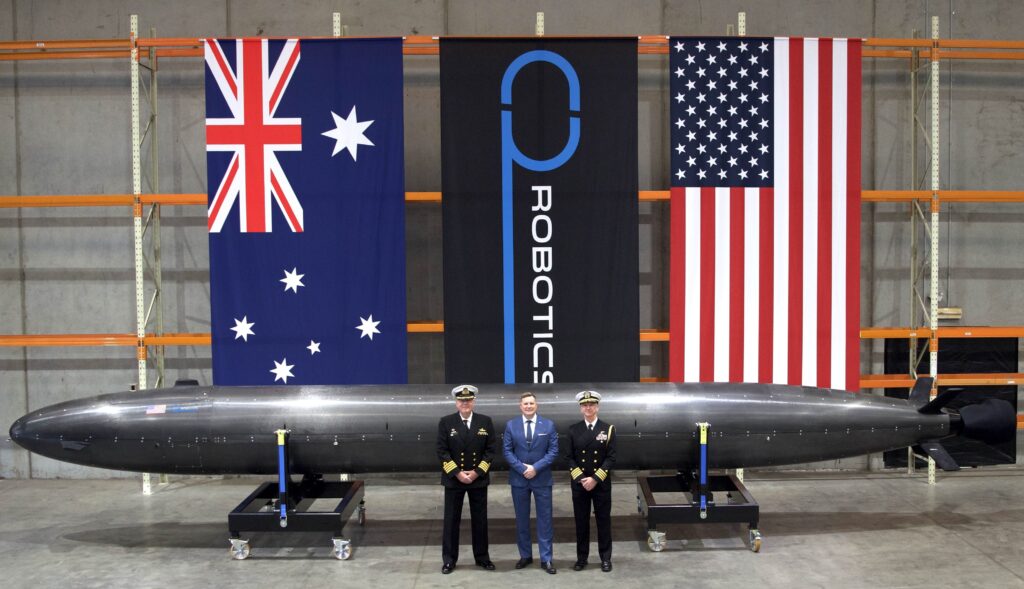
I think it is an evolving capability, that we don't fully understand. My own view is that the mission bay will be massively capable for drones. The Speartooth seems made for the Hunter. It weights in the order of a couple of tonnes, and a dozen could be held in the bay. A Hunter could patrol a region with several of these in the water out to around a 1000km.

I still have the view that onboard VLS capability is becoming less important as offboard missile drones come online. A Hunter or a Mogami travelling with several 8/16 cell missile drones for strike and defence, plus a few more over the horizon surface ISR drones with variable depth sonars, plus multiple speartooths out beyond that boundary, becomes a very capable and distributed force.

I think something like the above, once mature, starts to become very competitive against something like a type 55 and will be a problem for a submarine

I would suggest Hunters get used in open hostile waters, as part of a strike force, or independently, whereas Mogamis get used for escorts in more protected waters for civilian and army transports.
 

iambuzzard

Well-Known Member
We shouldn’t forget that, just like the Japanese with the Mogamis, the British, the Canadians and the Norwegians are all also in the same boat with us with a common hull form. I don’t know how much growth potential there is in the Type 26 base design and we’ve obviously heavily Australianised it, but we’re missing a significant opportunity if we don’t continue as much common development as possible.

Two continuous shipbuilding lines building flights of evolved Mogamis and Hunters - that we have evolved with our partners - could (and probably should) form the backbone of the RAN for half a century.

And this seems to be where we’re heading.
I hope so. We need sanity in this dangerous world.
 

Volkodav

The Bunker Group
Verified Defense Pro
Really what we needed were the Offshore Combatant Vessels that was recommended way back in the Rudd 2009 defence white paper. Unfortunately somebody looked at that and decided that OPVs and OCVs were the same thing forgetting that the former was just a constabulary vessel and the latter was a genuine combatant. I also suspect that some in the navy didn't really want to see this vessel take away focus and funding from its majors so they happily downgraded their requirements.

The Arafura to me can be seen as a stepping stone to what vessel will eventually go on to succeed them. The Capes are short lived vessels that will probably need replacing from the mid to late 30s so now is probably the time we should look at what will replace them and eventually the Arafura.

In the mean time we will have to make do with what we have. To me the Arafuras could still be useful vessels but not frontline combatants. They have lots of room for deploying and recovering drones and carrying out other support roles for the navy short of actual combat missions. They still have the potential to be useful ships even if they are not the perfect fit for what we really need.
For all intents and purposes the Mogamis are filling the old tier 3 / OCV / corvette gap. What we are missing is the appropriate tier 1 and 2 mix.
 

Volkodav

The Bunker Group
Verified Defense Pro
Yes, the changes were, quite frankly, a bit silly. A case of wish lists not being properly vetted, I think. We used to call the people who came up with such, “Ivans” - “I’ve an idea…”. They were never the people responsible for actually delivering the product, of course!

The proposed changes would have necessitated redoing quite a lot of the stress calculations, amongst other things. The Arafuras as they are would be an OK mine warfare mother ship; a few minor mods, not as extensive as those proposed, would actually make them pretty good in that role. As I’m now retired, I have no idea if that is on the cards but some of the comments recently by various senior officers about the future of the class suggest that it might be very possible. We certainly need the capability. Even though the Mogamis have some MW capability you would not want to have to devote them to it. Much better to use something not dissimilar to the Arafuras - a modern Ton class MHC anyone?
CORGI Commanding Officers Really Great Idea, should be drowned at birth.

We also need one for the stupidity associated with contracts.

What does my head in is additions and deletions of equipment, or changes in scope of what the equipment is expected to do, that hasnt had a corresponding change to requirements, and there is no context as to why the requirements and baseline no longer align.

There is a recurring issue with existing designs where obsolesence rolls into other, capability, driven design changes. It is what it is, but there is a multitude of people who pretend reality doesnt exist and make it harder to change the words in the contract than it is to change the design.

But when it is realised the design has to change for operational or safety reasons, they try and change the requirement instead, as if a waiver will remove a need.
 

Morgo

Well-Known Member
For all intents and purposes the Mogamis are filling the old tier 3 / OCV / corvette gap. What we are missing is the appropriate tier 1 and 2 mix.
I get where you're coming from Volk, but to be honest:
1) The Evolved Mogami is much more capable that the old Tier 3 proposals, and sits much more comfortably in Tier 2; and
2) I'm not convinced that a Tier 3 combatant is necessary. I don't think we can get something that has the range and firepower needed to be a proper combatant in our context in a sub 4000t package.

I think instead there is a much better case for leaving the Arafuras / Capes to the constabulary / patrol role (and potentially transferring them in their entirety to the ABF), and leaving the RAN to what it should be - the nation's battle fleet. And we should be focussed on right sizing the number of proper combatants that we're building.

For me the logic of the force structure is pretty simple - what is the operational effect you want?

My very much armchair view is if Australia is serious about simultaneously securing its SLOCs, protecting amphibious forces, and projecting power into the South Pacific, eastern Indian Ocean and northern archipelago, then the RAN needs to be able to put to sea, at any given time, the equivalent three credible surface action groups, comprised of a DDG, FFG and 2x GP frigates (plus SSNs obviously acting largely independently, besides maybe escorting a large amphib group).

If you accept that requirement the rule of three drives the rest. If you want 3 SAGs, you get to roughly 9 DDGs, 9 Hunters, 18 Mogamis and 9 SSNs.

That is why I think the official plan is still too thin. The current trajectory gives us 6 Hunters, 11 Mogamis, and a future replacement for the 3 Hobarts, within a force centred on 8 SSNs. That is a meaningful improvement, but it is still a fleet sized more for selective presence and denial than for sustained control of our approaches and persistent escort depth.

The real problem with the current numbers is not that they are “small” in a peacetime sense. It is that they are brittle in wartime. If you start with only 9 Tier 1 escorts in total, for example, the available force shrinks very quickly once you account for maintenance cycles, training pipelines, refits and battle damage. A force structure like the above gives you enough mass to absorb those normal losses of availability without collapsing the whole operational concept. Not because it sounds neat, and not because bigger is always better, but because it is the point where the RAN starts to look like a navy that can sustainably generate combat power in multiple theatres rather than just assemble a respectable looking order of battle for a one off engagement in one place at one time.

The other reason I like this structure is that it maps well to a continuous build. It's not fantasy fleet stuff. It's upping the tempo and committing to orders on existing programs for the long term. It would take us 30 years to get to this mass, but once we're there we would have a tremendous national asset, and for not much more (single digit billions p.a.) than the current plan.

If the future DDG is a Hunter derivative rather than a completely separate design, that gets even better. The yard is no longer switching between unrelated classes, it's building variants of the same family. Same broad production philosophy, same workforce, similar supplier base, similar combat-system spine. The Yanks have done something similar well with the Burke model of flighted evolution over decades.

Perhaps I'm missing something, but our current plan, where we might be able to muster a DDG, 2 FFGs and 4 GPs if we're lucky, simply isn't sufficient.

 

SammyC

Well-Known Member
I get where you're coming from Volk, but to be honest:
1) The Evolved Mogami is much more capable that the old Tier 3 proposals, and sits much more comfortably in Tier 2; and
2) I'm not convinced that a Tier 3 combatant is necessary. I don't think we can get something that has the range and firepower needed to be a proper combatant in our context in a sub 4000t package.

I think instead there is a much better case for leaving the Arafuras / Capes to the constabulary / patrol role (and potentially transferring them in their entirety to the ABF), and leaving the RAN to what it should be - the nation's battle fleet. And we should be focussed on right sizing the number of proper combatants that we're building.

For me the logic of the force structure is pretty simple - what is the operational effect you want?

My very much armchair view is if Australia is serious about simultaneously securing its SLOCs, protecting amphibious forces, and projecting power into the South Pacific, eastern Indian Ocean and northern archipelago, then the RAN needs to be able to put to sea, at any given time, the equivalent three credible surface action groups, comprised of a DDG, FFG and 2x GP frigates (plus SSNs obviously acting largely independently, besides maybe escorting a large amphib group).

If you accept that requirement the rule of three drives the rest. If you want 3 SAGs, you get to roughly 9 DDGs, 9 Hunters, 18 Mogamis and 9 SSNs.

That is why I think the official plan is still too thin. The current trajectory gives us 6 Hunters, 11 Mogamis, and a future replacement for the 3 Hobarts, within a force centred on 8 SSNs. That is a meaningful improvement, but it is still a fleet sized more for selective presence and denial than for sustained control of our approaches and persistent escort depth.

The real problem with the current numbers is not that they are “small” in a peacetime sense. It is that they are brittle in wartime. If you start with only 9 Tier 1 escorts in total, for example, the available force shrinks very quickly once you account for maintenance cycles, training pipelines, refits and battle damage. A force structure like the above gives you enough mass to absorb those normal losses of availability without collapsing the whole operational concept. Not because it sounds neat, and not because bigger is always better, but because it is the point where the RAN starts to look like a navy that can sustainably generate combat power in multiple theatres rather than just assemble a respectable looking order of battle for a one off engagement in one place at one time.

The other reason I like this structure is that it maps well to a continuous build. It's not fantasy fleet stuff. It's upping the tempo and committing to orders on existing programs for the long term. It would take us 30 years to get to this mass, but once we're there we would have a tremendous national asset, and for not much more (single digit billions p.a.) than the current plan.

If the future DDG is a Hunter derivative rather than a completely separate design, that gets even better. The yard is no longer switching between unrelated classes, it's building variants of the same family. Same broad production philosophy, same workforce, similar supplier base, similar combat-system spine. The Yanks have done something similar well with the Burke model of flighted evolution over decades.

Perhaps I'm missing something, but our current plan, where we might be able to muster a DDG, 2 FFGs and 4 GPs if we're lucky, simply isn't sufficient.
I think the future definition of a SAG is going to drastically change, not immediately, but I think by mid next decade systems are going to be different.

For a start, given the air surveillance, combat systems and EW suites fitted to the Hunter, it is a DDG in all but name and a few missile silos. I no longer see the distinction between the DDG and FFG terminology with the Hunter.

Missile silos will in future be offboard. We are not that far away from small drones that can sail autonomously in high sea states and travel in convoy with a large command ship. The LOCSV concept is all but dead, overtaken by smaller fully unmanned platforms that can hold 8 maybe 16 missiles in deck launchers. Given some of the remote weapon stations on the market, these things can come with their own compact self protection. Want a 100, 200, or 300 missiles; just use more drone boats.

Sensors will also be offboard. Similar drones with the deck launchers swapped out for small radars (like a navalised version of ceatac) can be placed a 100-200kms away from the command ship, massively expanding the surveillance range and early warning, and fully networked in. You no longer need a frigate picket ship to do this.

AI is also developing at lightening speed. I would view that in five-10 years a Hunter or Mogami would have the capacity to seriously reduce bridge, engine room and combat centre watchkeeping, near fully automating all these functions.

Furthermore, observing some of the videos from Boston Dynamics indicates that we are not that far away from having the ability to replace maintenance, bosun and even damage control roving crew with robots. A warship might in a decade be able to be staffed by 20% of the current requirement, with the rest managed by AI and robots.

So a SAG in the not distant future will resemble more of an advanced drone swarm, with crews at least partially mechanised.

An actual frigate or destroyer in this concept becomes a local command node with sensor synthesis, perhaps with final human authorisation. Maybe there is one surface combatant, possibly a second for redundancy, but there will not be the requirement for multiple.

Strictly speaking, if we have 20 surface combatants, then the above means every single one can form its own SAG.
 
Last edited:

StevoJH

The Bunker Group
I think instead there is a much better case for leaving the Arafuras / Capes to the constabulary / patrol role (and potentially transferring them in their entirety to the ABF), and leaving the RAN to what it should be - the nation's battle fleet. And we should be focussed on right sizing the number of proper combatants that we're building.
The RAN needs them, otherwise the first chance an officer will get at Independent command will be a Frigate or Destroyer.

They presumably also increase the number of training places you can have at sea, which will aid any future growth plans.
 
Top