The guy begging for interceptors and other weapons, whose country was freezing just days ago and whose electrical grid and energy infrastructure is severely degraded (lots destroyed completely), zero refining capacity, etc, tells the Brits that the new technology works better than the old systems because he has some iPad that lets him control the security in real time and see every enemy killed with video proof. Standing ovation, no doubt.
Last
December:
Ukraine is building nearly 1,000 specialized drones a day to counter Russia’s Iranian Shaheds.
Today:
Ukraine is capable of producing around 2,000 interceptor drones per day and can supply half that amount to its allies to help bolster their defenses, Zelensky says.
8 hours
earlier:
Zelenskyy says that to counter such attacks, Ukraine needs at least 2,000-3,000 interceptor drones.
Also talks about the cost of $10,000 to intercept a Shahed vs using a Patriot interceptor that costs $4M (from the article). Emphasizes that Ukraine can down drones more cheaply.
In
January:
While still defense minister just a month ago, Fedorov's predecessor Denys Shmyhal, claimed that the ministry was already delivering 1,500 interceptors per day to soldiers.
But, in February (the same article as above):
In the month that followed, Russian attacks knocked out heating for the rest of the season for many Kyivans. Shmyhal, previously the prime minister, moved over to the Energy Ministry, replacing a former colleaguerecently arrested for what authorities call a massive corruption scheme that gutted Ukraine's energy defenses.
And reality (same article):
"Honestly, we haven’t seen any changes yet," Vladyslav told the Kyiv Independent on Feb. 13. His unit, he says, doesn’t get enough Sting drones, and those that they receive still have no last-mile targeting.
Also:
In a Feb. 11 statement to the Kyiv Independent, Ukraine’s General Staff wrote that answering questions about interceptor effectiveness could "negatively affect the progress of the assigned tasks during the legal regime of martial law."
A US General
about Merops:
The weapon has logged more than 1,900 intercepts in combat, including surveillance and strike drones. A typical engagement lasts just a few minutes.[…]
"We're using the latest technology that's being fought in Ukraine right now," King said of Merops. He assesses that this system is responsible for up to 40% of Shahed shootdowns in Ukraine.
Report for February:
In February of 2026, Ukrainian interceptor drones destroyed over 1,500 Russian drones launched to attack Ukraine, reported Oleksandr Syrskyi, commander-in-chief of Ukraine’s army, on his Facebook.
And:
In addition to the missiles, Russia deployed 5,059 long-range drones against Ukraine last month.
So about 30% of RU long-range UAVs (that include Shaheds, primitive Gerberas, etc) were downed using these interceptor drones, which without a doubt, include Stings, Merops, and everything else that fits the description (an overview
here). That is, 30% if one believes the number cited by Syrsky (screeching my teeth here). So someone is lying. Clearly, both are.
Reality (the Kiev Post article as cited above):
Only recently have Ukrainian officials acknowledged even obliquely that interceptor drones have not lived up to their promise to fill in the gaps in traditional air defense.
"In conditions of difficult weather, the main and most effective means remain SAM missiles, which are all-weather. In favorable weather conditions, aviation, helicopters and drone interceptors are involved," Commander-in-Chief of Ukraine’s Armed Forces Oleksandr Syrsky wrote on Feb. 12, promising however that, "the quantity and quality of interceptor-drones is growing."
And:
The lack of air defense has, however, been painfully obvious. Over the winter, many Ukrainian figures including Ukrainian President Volodymyr Zelensky publicly touted the need for more ammunition donations for Western systems like Patriots, SAMP/Ts and NASAMs.
Zelensky said on Feb. 12 that "acceleration is needed with packages for our air defense. This is the key task right now not only for Ukraine, but for everyone in Europe. The Russians must not get used to the idea that their missiles and 'Shaheds' are helping them in any way."
The point being is that there is no some magic bullet of cheap intercepts that Ukraine miraculously possess. It’s nonsense and propaganda, along with the heavily advertised “fact” that Patriots are used to bring down Shaheds in the middle East (or Ukraine, for that matter). Probably the biggest argument here would be that these systems were never designed for it. Probably of hitting a slow-moving drone at an altitude of a few hundred feet is not exactly favourable (why not use the THAAD, which articles also suggested?). It’s nonsense. Remember the incident in 2018-19 (?) when the Houthis hit Patriot radars with these very drones and then launched ballistics and more drones and cruise missiles at the oil facilities in Saudi Arabia? Exactly how Ukraine works against Russian long-range AD batteries as well.
Furthermore, Merops are fully autonomous past launch, while Sting interceptors are mostly manual (and lack last-mile targeting as cited above). Sting interceptors are inferior in technology, without a doubt, and require experienced pilots to operate (training takes months (though I doubt it), according to the reports) and Ukraine does not have enough of these pilots). In addition, about the radars, crucial for operation of these interceptor drones (via Google translate from
Ukrainian):
There is now a very large request for Ukrainian radar stations. The military is very much praised. The queue for receiving a model from one domestic plant is already 13 months. Six months ago, the queue was 6 months. That is, our manufacturer lacks scaling. Demands are growing, and production capacity does not keep up with it.
Ukrainian technology is simpler and more stable to use by interceptor operators, because it is made for the appropriate purposes. And imports have many modes of operation and settings for different purposes, which causes difficulties.
Then there are repots that Netanyahu wants to talk to Zelensky and reach out for his help. I highly doubt that Israel doesn’t have something that Ukraine does.
So much nonsense in the past couple of weeks on this subject. Funny enough, not a single article that I read cited anyone but UA officials, representatives of the UA drone manufacturers, basically anyone other than Ukrainians. Some huge deal was in the works with the Saudis (or the UAE?) that was supposed to be signed on March 11. Crickets. Saudis were not available for comment. And so was no one else advertised. Delusion goes well beyond though - the guy is
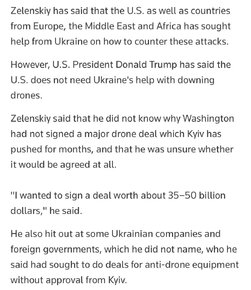
planning to sign some deal with the US for his drones worth $35-50B (yes, billion, US dollars), but he does not know why Washington is not responding and is not sure if the deal will go through (imagine if he is serious!):
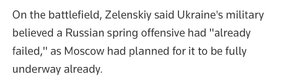
He also proclaimed in the same article that the RU spring offensive had already failed before it even began (that is what he said, literally):
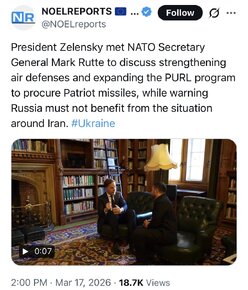
The guy also, at the same time, wants to strengthen the air defences and… get more Patriots (is someone going to tell him? has Rutte told him?). But do not forget that Russia
must not benefit from the war in the Gulf!
Caught a Ukrainian meme today on the subject of interceptor drones:
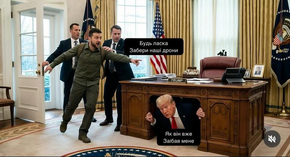
Zelensky says something like “Please, just take our drones”; while Trump says something like “I am so fucking tired of this guy” (much harder to translate this part - there is more… “soul”, for the lack of a better word, in Slavonic languages, lol; the meaning is basically the rudest way to talk about a sexual intercourse that that has gone way too long for the complaining party).
The guy from Belgium, in the meantime, straight up says that the EU should make a deal with Russia and go back to buying its cheap energy:
"There is only one method left: making a deal," he said

www.euractiv.com
Druzhba pipeline is also going to be fixed, though it will take a month and half: