The Russian-Ukrainian War Thread

Feanor

Super Moderator
Staff member
I don't disagree, but let's not forget who put that ladder there. Russia can step off whenever it wants and the war is over. Ukraine can't. Its only way down is a shattering fall.

They both have a very different set of options on there.
This is simply not true. Ukraine could have chosen not to attack civilian shipping. Russia's attacks on Odessa were of limited impact at best before the campaign against civilian shipping took off. Ukraine opened the Overton window a little wider. The same goes for attacks on civilian trucks. I think the lesson here is that despite people repeatedly claiming that Russia has nowhere left to escalate, this is really not true. Russia continues to have escalation options, and there are reasons to be careful with how Ukraine chooses to escalate.

I do think Ukraine is strategically in a dead end. Don't escalate, and they're on a slowly losing path. Do escalate, and face potentially far greater Russian retaliation. This is why I think Ukraine, in a big picture sense, needs to get the best deal they can now, and by now I do mean near future. I don't think this is going to be a comfortable or pleasant deal. It will require giving up substantial territory permanently, and accepting a painful new reality. But it will provide an exit out of this strategic dead end. Ukrainian leadership prefers to kick the can down the road and hope for some sort of force majeure to provide an opening for a better deal in the future. It's a dangerous gamble with a real potential for significant additional damage, and further problems.

Are you implying Ukraine is a proxy? If so, whose, and by what definition of proxy?
Regardless of the terminology, I think it's clear the collective West is unhappy with Russia and is supporting Ukraine against Russia as well as using sanctions and other political tools to signal their displeasure to Russian leadership. If this doesn't work the collective west can always leave Ukraine in the lurch and let them lose. It would be unpleasant but very possible. Russia is itself invested and therefore would have a much harder time just walking away, especially when we consider the fate of places like Donetsk, Lugansk, and Crimea.
 
Last edited:

Rob c

The Bunker Group
Verified Defense Pro
This is simply not true. Ukraine could have chosen not to attack civilian shipping. Russia's attacks on Odessa were of limited impact at best before the campaign against civilian shipping took off. Ukraine opened the Overton window a little wider. The same goes for attacks on civilian trucks. I think the lesson here is that despite people repeatedly claiming that Russia has nowhere left to escalate, this is really not true. Russia continues to have escalation options, and there are reasons to be careful with how Ukraine chooses to escalate.
I think that the reference is more about that it was Russia that attacked Ukraine and if they stepped back across the boarder the war is over, of coarse this will not happen, but Ukraine does not have this option.
 

seaspear

Well-Known Member
An interesting tactic used by Ukraine has been to air drop ground drones behind Russian lines , Im not sure how far behind lines these may be dropped ,but would have to assume this may be another tactic being thought about by militaries around the world
Ukraine says heavy bomber drones air-dropped exploding war robots miles behind Russian lines during a secretive operation
Top Stories
 

personaldesas

Active Member
I think that the reference is more about that it was Russia that attacked Ukraine and if they stepped back across the boarder the war is over, of coarse this will not happen, but Ukraine does not have this option.
Correct.

Regardless of the terminology, I think it's clear the collective West is unhappy with Russia and is supporting Ukraine against Russia as well as using sanctions and other political tools to signal their displeasure to Russian leadership. If this doesn't work the collective west can always leave Ukraine in the lurch and let them lose. It would be unpleasant but very possible. Russia is itself invested and therefore would have a much harder time just walking away, especially when we consider the fate of places like Donetsk, Lugansk, and Crimea.
Terminology matters because "proxy", for me at least, implies something specific: that Ukraine fights on someone else's behalf, at their direction, and hasn't decided for itself that this is a fight worth fighting. That's why I asked what we mean here, cause it could be a misunderstanding of what we're talking about.

I agree that Russia is invested. So is Ukraine, even more so. It's their country that's under attack. And the West clearly backs Ukraine because, for its own interests, it doesn't want Ukraine to lose too badly. But IMHO aligned interests don't make this a proxy war. If they did, we'd have to call Russia a proxy of North Korea, which has sent weapons and even troops. Or of China, for that matter.
 
Last edited:

rsemmes

Active Member

Feanor

Super Moderator
Staff member
Terminology matters because "proxy", for me at least, implies something specific: that Ukraine fights on someone else's behalf, at their direction, and hasn't decided for itself that this is a fight worth fighting. That's why I asked what we mean here, cause it could be a misunderstanding of what we're talking about.
I don't think proxy means they solely fight on someone else's behalf. I think a proxy is when a more powerful party doesn't want to get involved in a conflict directly but instead uses one of the sides in the conflict to advance their interests against the other. For example - the collective west is unhappy with Russia's aggression against Ukraine and wants to do something about it but is unwilling to get involved in the fight directly and instead fight against Russia through a proxy. It doesn't mean the proxy doesn't have something to fight for too. They might have an even better reason to fight. It does however create a potential conflict of interest, and this is where describing Ukraine as a proxy can be quite meaningful. In my opinion it's not in Ukraine's best interest to keep fighting. I think Ukraine got the best deal they could have at Instanbul in '22, and subsequent deals are likely to get worse. I also think the Anchorage deal was like the best Ukraine could have gotten at that time, and even that is probably no longer available (though something somewhat close to it probably is). But for the west continuing to weaken Russia through this protracted war, and keep Russia engaged might be worth the resources being expended. Notice I use the term "might". It's not clear that this is in fact the case. But it's not impossible to make that argument. Hence the question of Ukraine being a proxy becomes very relevant.

Case in point, it appears the Encyclopedia Brittanica provides the Russo-Ukrainian War (they cheerfully call it the War in Ukraine).


I agree that Russia is invested. So is Ukraine, even more so. It's their country that's under attack. And the West clearly backs Ukraine because, for its own interests, it doesn't want Ukraine to lose too badly. But IMHO aligned interests don't make this a proxy war. If they did, we'd have to call Russia a proxy of North Korea, which has sent weapons and even troops. Or of China, for that matter.
Russia is not a proxy of North Korea because it's more powerful than North Korea and because North Korea isn't actually invested in defeating Ukraine. For them this appears to be about getting experience in the fight, exposure to modern technology, and getting things from Russia.

I think that the reference is more about that it was Russia that attacked Ukraine and if they stepped back across the boarder the war is over, of coarse this will not happen, but Ukraine does not have this option.
But this misses the point entirely. Ukraine didn't have one moment after which they were locked in to a deterministic path. Ukraine has had many choices to make after the war started. Ukraine had many decisions to make tactically, strategically, and politically. To simply say "well Ukraine had to do this thing that's both criminal and has a bad outcome wasn't their choice because Russia invaded" is foolish at best and dishonest at worst. When Ukrainian service members deliberately strike civilian transit, execute POWs, or attack civilian shipping, these are choices. Russia's invasion did not magically predetermine that Ukraine would do this. And "if not but for" logic is fundamentally wrong. Otherwise one could argue that really Lenin is to blame for granting Ukraine independence from Russia back in 1917, or some other suitable irrelevant historic figure.
 

Rob c

The Bunker Group
Verified Defense Pro
Russia's invasion did not magically predetermine that Ukraine would do this. And "if not but for" logic is fundamentally wrong. Otherwise one could argue that really Lenin is to blame for granting Ukraine independence from Russia back in 1917, or some other suitable irrelevant historic figure.
No, but if Russia had not invaded then none of it would have happened, so the logic is not fundamentally wrong, flawed yes, but far from fundamentally wrong.
 

personaldesas

Active Member
I don't think proxy means they solely fight on someone else's behalf. I think a proxy is when a more powerful party doesn't want to get involved in a conflict directly but instead uses one of the sides in the conflict to advance their interests against the other.

[...]

Case in point, it appears the Encyclopedia Brittanica provides the Russo-Ukrainian War (they cheerfully call it the War in Ukraine).

Yeah, Britannica's definition is wider than mine. It's also wider than yours. "More powerful party" and "invested in the outcome" are your additions. So I don't think it was outlandish of me to ask for a definition, given how we seem to diverge.

With either definition you mention, I agree it's a proxy war.

By Britannica's definition, one could reasonably call this a proxy war between the West and China and Iran, with Russia and Ukraine as the proxies. Britannica names both sets of backers. North Korea doesn't fit, because Britannica's third parties stay out of the fighting, and North Korea sent troops who fought.

By yours, calling it a proxy war between the West and China is reasonable, too.
 

personaldesas

Active Member
For example - the collective west is unhappy with Russia's aggression against Ukraine and wants to do something about it but is unwilling to get involved in the fight directly and instead fight against Russia through a proxy. It doesn't mean the proxy doesn't have something to fight for too. They might have an even better reason to fight. It does however create a potential conflict of interest, and this is where describing Ukraine as a proxy can be quite meaningful. In my opinion it's not in Ukraine's best interest to keep fighting. I think Ukraine got the best deal they could have at Instanbul in '22, and subsequent deals are likely to get worse. I also think the Anchorage deal was like the best Ukraine could have gotten at that time, and even that is probably no longer available (though something somewhat close to it probably is). But for the west continuing to weaken Russia through this protracted war, and keep Russia engaged might be worth the resources being expended. Notice I use the term "might". It's not clear that this is in fact the case. But it's not impossible to make that argument. Hence the question of Ukraine being a proxy becomes very relevant.
If these assumptions hold, I agree with your conclusion:

- Istanbul '22 was a real deal Ukraine could have signed.
- Russia would have kept to it.
- Every deal since has been worse than the last.
- A deal now would hold, unlike Minsk I and II.
- The West wants a long war and steers Ukraine's choices toward it against Ukraine's actual will.

I just don't see these as undisputed facts yet. Especially the last one. If anything, the US has recently pushed Ukraine toward a settlement, including pausing aid and intelligence sharing in 2025. That's the opposite of a backer keeping its proxy fighting.
 

personaldesas

Active Member
But this misses the point entirely. Ukraine didn't have one moment after which they were locked in to a deterministic path. Ukraine has had many choices to make after the war started. Ukraine had many decisions to make tactically, strategically, and politically. To simply say "well Ukraine had to do this thing that's both criminal and has a bad outcome wasn't their choice because Russia invaded" is foolish at best and dishonest at worst. When Ukrainian service members deliberately strike civilian transit, execute POWs, or attack civilian shipping, these are choices. Russia's invasion did not magically predetermine that Ukraine would do this. And "if not but for" logic is fundamentally wrong. Otherwise one could argue that really Lenin is to blame for granting Ukraine independence from Russia back in 1917, or some other suitable irrelevant historic figure.
No, but if Russia had not invaded then none of it would have happened, so the logic is not fundamentally wrong, flawed yes, but far from fundamentally wrong.
I think I was misunderstood. I didn't say Ukraine had no choices. As I said, I don't disagree that both sides are escalating.

My point is about how we judge those escalations. Take a fist fight. A much bigger guy jumps a smaller guy and beats him up. The big guy can walk away whenever he wants. The small guy can't. Now two scenarios: the big guy pulls a knife, or the small guy does. Both are escalations. I'd still judge them differently.

Was it really in the best interest of the small guy to pull the knife? Maybe. It might make the big guy walk away. Or the big guy now pulls a knife too, and now the small guy is really screwed. That's a fair question, and I think it's the one that was raised.

But for the small guy, it's a question of whether it's smart. For the big guy, it's a question of whether it's right at all. He started the fight and can end it any time. Every escalation from him expands a fight he chose. The small guy is trying to get out of one he didn't.

That doesn't excuse everything. Everyone still has agency. Executing POWs is a war crime, whoever does it. But that's what I meant by who put the escalation ladder there.
 
Last edited:

personaldesas

Active Member
Ok, but if the opposition backed by the west didn't overthrow Yanukovych would Russia have invaded?
So in this scenario, whose fault is it? The Ukrainian opposition's, for rejecting Russia's preferred president? Or the West's for somehow manipulating Ukrainians into removing a president they actually all loved? Then the liberators in the east will be welcomed with open arms any day now?
 

KipPotapych

Well-Known Member
Are you implying Ukraine is a proxy? If so, whose, and by what definition of proxy?
Yes, absolutely, Ukraine is a proxy. And here by proxy I mean someone (or something, ie some outside entity) who/that will absorb an absolute majority, like virtually 100%, of retaliation (death and destruction) to our escalation (so it is our proxy, by definition). In the current arrangement, we are home free, for the most part. That is, until Russia finds a way to keep the status quo in this arrangement while inflicting more physical damage to us directly. Or, alternatively, if we escalate further. It also looks like there is some confusion here in regard to escalation in general, but later on that (maybe).

In other words, we have way more freedom of scope of actions and number of options before we cross the line (call it moving goal posts). The tricky part is we don’t know where that line actually is. Russia’s choices are much more limited because our red line it doesn’t want to cross is fairly well or at least better defined (at least in perception), so it can mostly retaliate or escalate by hurting Ukraine more than it already does and their options here are still plentiful. Their main problem is that it has no effect on us and does not limit us in any way, the aforementioned red line aside, as long as Ukraine itself finds that degree of hurt acceptable. Thus, in this current arrangement we can cause significant damage to Russian forces, infrastructure, civilian and military, etc, while Russia cannot return the favour. It follows, that Ukraine is a proxy at war, one that Russia does not have. Supposedly, we are not at war with Russia, but Ukraine is and vice versa.


The more interesting part is how we got here, to this arrangement. The answer is commitment. Yes, something I talked about numerous times (ad nauseam?). I talked plenty about our side, but only briefly about the Russian behaviour. There is no epic revelations here though, but a simple and natural process. To begin, their signalling from the very beginning was extremely weak and wrong. All that nonsense from Putin about “stuff you have never seen before” or whatever he said… Ok, I will actually pull it up…

No matter who tries to stand in our way or all the more so create threats for our country and our people, they must know that Russia will respond immediately, and the consequences will be such as you have never seen in your entire history.

The Kremlin website refuses to load, so I used AI to pull that out (the original text is here, dated Feb 24, 2022: https://en.kremlin.ru/events/president/news/67843)

He started from the top of the top of the top top (laughing). That was… at the very least irrational. I mean it was, perhaps, aligned with his (and most parties’ involved) expectations, so it was not completely retarted. That was probably just an indication of a lack of plan B more than anything else though. The problem (and a huge one), however, is that he “committed” to something he had no intention of implementing from the start. Sure, “threats for our country” is very vague (and it still holds true, actually), but words matter and so does perception, and, more importantly, consistency. Once the supply of anti-tank and other (“minor”) weapons began pretty much immediately, Putin was done. He lost all credibility (“tries to stand in our way” followed by “consequences […] you have never seen in your entire history”). At the same time, Russia committed to or accepted the normality of external military aid to Ukraine. That was a bug mistake on their part. The response should have been then and clear. While I have ideas, I am not going to go over what and how (it also doesn’t matter now), but surely it was possible to reinstate credibility via commitment and consistency and show that you mean business. Yet again, the expectations were probably different and the actions were not completely unreasonable (a question mark here).

Since the latter didn't happen, the rest is history. Russia accepted every next step as part of progression of the war they initiated. Occasional (often unreasonable) threats (though from unofficial sources) while committing to acceptance and lack of credibility to begin with is not how things work in the real world. Now the problem here is that we do not know what the red line actually is. Does Russia? There is enough ambiguity here that some genuinely believe (or appear to do so) that the line does not exist at all. This is a huge mistake as well.

At the very least, we know with a fair degree of certainty that they are ready to use nuclear weapons if a strong possibility of a (military) defeat exists. Remember the 50/50 stuff in the fall of 2023, for example? Needless to say, things change and as the general progression goes, one who commits to a bunch of smaller, incremental things, he is much more likely to commit to something bigger. Also needless to say, I do not believe that a defeat is on the table among those things they would commit to. I had already outlined my view on how that works out.

What works for them now is that they have been consistent after the initial mistakes were made, mistakes that changed everything. The official statements are levelled and consistent. I am not referring to some “we liberated X village/town” because that has no relevance (unless the end result will be freezing the front at the line of contact). Anyway, a bit of deviation. But hope the meaning of a proxy in this context is clear.

 

KipPotapych

Well-Known Member
I think I was misunderstood. I didn't say Ukraine had no choices. As I said, I don't disagree that both sides are escalating.

My point is about how we judge those escalations. Take a fist fight. A much bigger guy jumps a smaller guy and beats him up. The big guy can walk away whenever he wants. The small guy can't. Now two scenarios: the big guy pulls a knife, or the small guy does. Both are escalations. I'd still judge them differently.

Was it really in the best interest of the small guy to pull the knife? Maybe. It might make the big guy walk away. Or the big guy now pulls a knife too, and now the small guy is really screwed. That's a fair question, and I think it's the one that was raised.

But for the small guy, it's a question of whether it's smart. For the big guy, it's a question of whether it's right at all. He started the fight and can end it any time. Every escalation from him expands a fight he chose. The small guy is trying to get out of one he didn't.

That doesn't excuse everything. Everyone still has agency. Executing POWs is a war crime, whoever does it. But that's what I meant by who put the escalation ladder there.
I don’t think this example works because it is easy to show that the small guy’s actions are irrational. For example, the small guy in this situation knows that the big guy also has a knife, which is also bigger. Pulling a knife would not be rational. This exact process can actually be observed in real life in this very case.

At the same time, the bigger guy has imposed conditions for the beating to stop at any time, as long as the small guy accepts those conditions. There is no right or wrong here. The bigger guy, just like the small guy, is convinced he is right and is determined to keep the beating until he gets what he wants and he wants more as the fight goes on, which is completely rational and expected. There is no ambiguity here whatsoever. The hope, in your example, of the small guy to be punching back so that the big guy gives up is also irrational.
 

Feanor

Super Moderator
Staff member
So in this scenario, whose fault is it? The Ukrainian opposition's, for rejecting Russia's preferred president? Or the West's for somehow manipulating Ukrainians into removing a president they actually all loved? Then the liberators in the east will be welcomed with open arms any day now?
The opposition removed a lawfully elected president in what was effectively a coup d'etat executed by an active minority in the capital. It doesn't matter who Russia preferred, it does matter that Yanukovich won an election in Ukraine.

Yeah, Britannica's definition is wider than mine. It's also wider than yours. "More powerful party" and "invested in the outcome" are your additions. So I don't think it was outlandish of me to ask for a definition, given how we seem to diverge.

With either definition you mention, I agree it's a proxy war.

By Britannica's definition, one could reasonably call this a proxy war between the West and China and Iran, with Russia and Ukraine as the proxies. Britannica names both sets of backers. North Korea doesn't fit, because Britannica's third parties stay out of the fighting, and North Korea sent troops who fought.

By yours, calling it a proxy war between the West and China is reasonable, too.
Agreed. Not unreasonable.

If these assumptions hold, I agree with your conclusion:

- Istanbul '22 was a real deal Ukraine could have signed.
Yes, an assumption.

- Russia would have kept to it...
...- A deal now would hold, unlike Minsk I and II.
These two are connected, and it's not Russia that sabotaged the Minsk Accords. The Minsk Accords were an outcome Russia was satisfied with. Ukraine signed them and then sabotaged implementation. People keep forgetting just what the Minsk Accords required from Ukraine.

- Every deal since has been worse than the last.
I don't think this is an assumption. Leaving aside vague maximalist demands made for public consumption, all the deals we've had information on that were the result of real negotiations trended in a bad direction for Ukraine. Granted we haven't gotten many, but I think it's enough to conclude that there's a trajectory here.

- The West wants a long war and steers Ukraine's choices toward it against Ukraine's actual will.
Countries are large and complex institutions. Even people often act as individuals in a inconsistent and contradictory manner. Countries even more so. I'm not sure Ukraine has a singular will about the outcome of the current war. Remember we keep seeing polling data that shows Ukrainians are against continuing the mobilization and are also against territorial concessions to Russia. But they're also not volunteering to serve. So Ukraine's will is... make Russia lose, magically, without any real military effort on Ukraine's part? There is a complex balancing act here between what it would cost to achieve a given outcome and what external resources (without which Ukraine faces defeat) will be available. And that decision can be badly skewed by misaligned incentives, and by foreign influence. I don't think the west can make the Ukrainian public fight if they're absolutely against it. But the collective west can help shape narratives and perceptions, and manage public opinion, make a continuation of the fight accepted if not outright preferred.

I just don't see these as undisputed facts yet. Especially the last one. If anything, the US has recently pushed Ukraine toward a settlement, including pausing aid and intelligence sharing in 2025. That's the opposite of a backer keeping its proxy fighting.
Most recently, yes, the US has and has failed to get results, partially due to the ineptitude of America's current leadership. But it does cut against the proxy argument.
 

KipPotapych

Well-Known Member
Yeah, Britannica's definition is wider than mine. It's also wider than yours. "More powerful party" and "invested in the outcome" are your additions. So I don't think it was outlandish of me to ask for a definition, given how we seem to diverge.

With either definition you mention, I agree it's a proxy war.

By Britannica's definition, one could reasonably call this a proxy war between the West and China and Iran, with Russia and Ukraine as the proxies. Britannica names both sets of backers. North Korea doesn't fit, because Britannica's third parties stay out of the fighting, and North Korea sent troops who fought.

By yours, calling it a proxy war between the West and China is reasonable, too.
But it would be getting completely out of hand here, haha. Russia can be Iran’s proxy in the Security Council, for example (and even then it is not an appropriate assessment because Russia will never vote against its perceived interests and Iran cannot change that). It cannot be its proxy in the war, by definition. Not only because it is not even a part of the equation and hasn’t been for a long time, but it also has no influence over neither the continuation nor the direction of the war. Iran has no influence on Russia’s decision making or/and its ability to wage war. Iran has no interest in regard to Ukraine and is not in any competition with “Europe” either. Russia cannot do any damage to the United States in the current arrangement, as discussed above. But Iran can be Russia’s proxy in its war with the United States, for example, and the United States can stop delivery of critical weapons to Ukraine (as a result of the war) or Russian sponsorship can cause recalculation on the part of the US in regard to its relationship with Russia as far as risk/benefit assessment is concerned, for example. No similar effect can be achieved by Iran from Russia’s war in Ukraine. It can gain some knowledge base in exchange for critical assistance at the time when it is desired, but that does not fall under a proxy-third party arrangement, but mutually beneficial transactional relationship.

Similar argument can be made for North Korea.

Also, it kind of follows that a proxy cannot be more powerful and superior in every aspect than the benefactor or, what is known as, external power behind the proxy. Neither Iran nor North Korea are operating in the same world with Russia, so to speak.

As for China, I think a better proposition would be that there is no individual proxy here, but all parties are because it would simply prefer a prolonged but controlled war of attrition that affects both Russia and the “west” equally. As long as they can sell their manufactured goods to every one, they are good.

Something like that.
 

Rob c

The Bunker Group
Verified Defense Pro
Ok, but if the opposition backed by the west didn't overthrow Yanukovych would Russia have invaded?
No country as the right to invade another because they don't like the politics of that country and there have been democratic elections since that incident that have pointed in which direction the population wanted to progress.
 

KipPotapych

Well-Known Member
So in this scenario, whose fault is it? The Ukrainian opposition's, for rejecting Russia's preferred president? Or the West's for somehow manipulating Ukrainians into removing a president they actually all loved? Then the liberators in the east will be welcomed with open arms any day now?
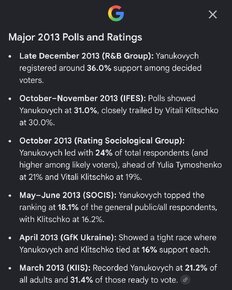
In addition to what Feanor said above on the subject, does it matter if he was loved by everyone or by some, whether majority or minority? Purely for information, Google AI’s response to “Yanukovych ratings 2013” because I am not interested in digging it myself as I already had previously (take it for what it is, though it is no wrong):

IMG_6937.jpeg

In other words, if the presidential election was hold in late December 2013, after signing the agreement with Russia earlier in the middle of the month, he would likely be reelected to his post. I do not believe wether he is “Russian-preferred” or “west-preferred” should have any relevance. He was a Ukrainian-preferred president at the time with approval ratings and general polling higher than any other political figure in the country at the time. Does this change you perspective of Ukrainian opposition “rejecting” the President of Ukraine?

By analogy, if Trump succeeded with his nonsense on January 6, 2021, would that be kosher? Note that the events of 2013-14 in Ukraine are portrayed as democracy in action and everyone (figuratively speaking) cheered. Trump’s shenanigans should be viewed in the same light if we want to keep it all in the same perspective. I guess one thing that was missing in Washington in 2021 is Antonov giving out burgers to the participants while cheering them on.

My point is that because the opposition “rejects” the elected leader or his/her initiatives… frankly, nobody cares. All opposition has to do is propose a better plan of action, win support of the populace and the next election. I gather things may have gone differently for Ukraine (and Russia, as well as the world). Or not? We will never know as, unfortunately, this is not a simulation that can be reset and replayed.
 
Top