Is there any advantage for the RAN to disperse the basing of their larger vessels to other deep water harbours away from East Base West e.g. Port Kembla ,H.M.A.S Port Coonawarra Darwin which is the closest deepwater port to Asia. It seems that the East Base is based on a heritage factor from the time of ships of sail any thought?

Royal Australian Navy Discussions and Updates 2.0
- Thread starter OPSSG
- Start date

Todjaeger
Potstirrer
It might be worth approaching your question from another angle. What would be (or what are) some of the issues with having vessels homeported at other RAN facilities aside from FBE?Is there any advantage for the RAN to disperse the basing of their larger vessels to other deep water harbours away from East Base West e.g. Port Kembla ,H.M.A.S Port Coonawarra Darwin which is the closest deepwater port to Asia. It seems that the East Base is based on a heritage factor from the time of ships of sail any thought?
One issue that I seem to recall cropping up repeatedly are retention issues caused by personnel getting posted to bases in areas with less opportunities available for partners/families, and/or the facilities being a very long way away from family. It has been my understanding that the desire to establish a RAN sub facility somewhere on the East Coast is related to issues the RAN had with attracting and retaining submariners with all RAN sub ops being homeported at FBW.
Strange that affects the RAN but not the rest of ADF…It might be worth approaching your question from another angle. What would be (or what are) some of the issues with having vessels homeported at other RAN facilities aside from FBE?
One issue that I seem to recall cropping up repeatedly are retention issues caused by personnel getting posted to bases in areas with less opportunities available for partners/families, and/or the facilities being a very long way away from family. It has been my understanding that the desire to establish a RAN sub facility somewhere on the East Coast is related to issues the RAN had with attracting and retaining submariners with all RAN sub ops being homeported at FBW.
/sarcasm off.
It obviously does, RAN just seems exempt from the push to house all ADF units in the North.
iambuzzard
Well-Known Member
It's a long way for a potential enemy to get at the main fleet units at Fleet Base East or West. Up north they're close to Dodge. Down south we'd usually get some sort of warning to a missile attack and hopefully get defenses in place.
Another way to look at it can facilities be in place for ships to replenish elsewhere during hostilities that cuts back on travel time for ships that may have expended their munitions and need to quickly replenish , it might be ships returning to a known predictable port are at risk e.g. mines submarines. The R.A.A.F has quite a number of airfields that provide in a way a similar backup easing dispersalIt's a long way for a potential enemy to get at the main fleet units at Fleet Base East or West. Up north they're close to Dodge. Down south we'd usually get some sort of warning to a missile attack and hopefully get defenses in place.
Todjaeger
Potstirrer
IMO the RAAF 'bare base' strategy is a good one, but a bit of an 'apples to oranges' comparison if one is trying to apply it to the RAN. The physical infrastructure involved in a RAAF base is quite different from that of a RAN base which supports ships, or even just that of a working port with fuel and cargo transfer capabilities. Consider for instance, just how many ports or even just deep water anchorages and harbours there are along Australia's northern and northwest coasts.Another way to look at it can facilities be in place for ships to replenish elsewhere during hostilities that cuts back on travel time for ships that may have expended their munitions and need to quickly replenish , it might be ships returning to a known predictable port are at risk e.g. mines submarines. The R.A.A.F has quite a number of airfields that provide in a way a similar backup easing dispersal
There are actually a lot of deep-water ports in Australia outside of major cities, think of mining and LNG facilities (List of ports in Australia - Wikipedia) The issue would be the ammunition and supplies to some of these remote areas, but in a conflict I think our road train semis and cargo planes would be very busyIMO the RAAF 'bare base' strategy is a good one, but a bit of an 'apples to oranges' comparison if one is trying to apply it to the RAN. The physical infrastructure involved in a RAAF base is quite different from that of a RAN base which supports ships, or even just that of a working port with fuel and cargo transfer capabilities. Consider for instance, just how many ports or even just deep water anchorages and harbours there are along Australia's northern and northwest coasts.
Most of the places on that list are very minor ports and very limited in the size of ship that can enter, let alone come alongside a dock. Especially the old river ports, many of which are long over due for dredging.There are actually a lot of deep-water ports in Australia outside of major cities, think of mining and LNG facilities (List of ports in Australia - Wikipedia) The issue would be the ammunition and supplies to some of these remote areas, but in a conflict I think our road train semis and cargo planes would be very busy
Yes, but so is it with APIN and the RAAF bases we’ve pushed north.It's a long way for a potential enemy to get at the main fleet units at Fleet Base East or West. Up north they're close to Dodge. Down south we'd usually get some sort of warning to a missile attack and hopefully get defenses in place.
I am curious why they are apparently not so important as the RAN and why they don’t struggle to recruit apparently (they do…) with remote postings but the RAN does.
We Don’t put active RAAF bases there either…IMO the RAAF 'bare base' strategy is a good one, but a bit of an 'apples to oranges' comparison if one is trying to apply it to the RAN. The physical infrastructure involved in a RAAF base is quite different from that of a RAN base which supports ships, or even just that of a working port with fuel and cargo transfer capabilities. Consider for instance, just how many ports or even just deep water anchorages and harbours there are along Australia's northern and northwest coasts.
But we do at Darwin, Tindal and Townsville...
Last edited:
Todjaeger
Potstirrer
Given the volume of commercial shipping passing through the Port of Townsville as well as the limited space in the port (relative to the volume of traffic) and shipping lanes and channels into/out of the Port, I am somewhat dubious that getting a RAN warship to Townsville for reloading would be significantly faster. That is even before any consideration would be given towards the costs involved in shipping and safe storage of munitions to the port so that a warship could be reloaded. I do not know enough about the shipping channels into the port through the Great Barrier Reef to know for certain, but I would not be surprised if the available channels would be quite limited even in the event of restrictions being lifted due to wartime conditions.The distance between Townsville and Sydney is over 1680 kilometres ,getting a ship replenshed quickly is likely going to be important if you are talking about loading vls tubes which there are various means of transporting
I would love to see any sort of reasonable plan to establish a RAN base adjacent to/nearby RAAF Base Tindall. It could be fascinating to see how that might work. AFAIK HMAS Coonawarra is the closest RAN base to Tindall (and not far from RAAF Base Darwin) with patrol boats ported there.We Don’t put active RAAF bases there either…
But we do at Darwin, Tindal and Townsville...
I recall there having been some discussion here on DT about expansion work in/around Darwin, but as part of those discussions, there would really need to be some significant infrastructure development and expansion before it would really be viable for the RAN to permanently homeport a major warship. The Darwin Ship Lift (already the largest in northern Australia) would likely need to be upgraded, expanded or replaced before Darwin could handle some of the maintenance or likely repair needs for RAN frigates and destroyers. Consideration also needs to be given for the impact the tidal range can have on vessels entering/leaving Darwin.
Todjaeger
Potstirrer
Add into that the impact the tidal range has upon a port or harbour, and/or the amount of shallow water approaches. When I looked at Gove in Arnhem Land, it appears that the quay used by Port Gove used to load large vessels projects nearly a km into the water in order to reach vessels. Not sure the max number of vessels that could be alongside at the same time, but I could easily see trying to refuel and especially re-arm vessels using such a setup would be impractical at scale.Most of the places on that list are very minor ports and very limited in the size of ship that can enter, let alone come alongside a dock. Especially the old river ports, many of which are long over due for dredging.

Tindall is about 300 k inland, difficult to establish a Navy support facility adjacent to that. The nearest port is, surprise surprise, Darwin, where as you may know considerable effort has in recent years been put into providing facilities for major surface units.
You can establish a forward operating base for warships at almost any significant port (although given the existing Navy presence, Cairns is better than Townsville which is a dog of a port). However, a full base, the base port, of MFUs and submarines needs to be in close proximity to major population area, both for spouse and family reasons and also so that there is sufficient workforce and infrastructure available to support the units concerned.
And, Navy support infrastructure doesn’t come cheap. The last estimate I saw to relocate the FBE facilities was north of 10 billion dollars, and that was nearly 20 years ago.
Developing regional FARP networks would be advantageous.
Re the issue of vacating the field to rearm [VLS], it’s good to remember that REDFOR expeditionary units would have the same problems.
Unless they have likely solutions that would facilitate rearming more locally.
If so what would they be?
Re the issue of vacating the field to rearm [VLS], it’s good to remember that REDFOR expeditionary units would have the same problems.
Unless they have likely solutions that would facilitate rearming more locally.
If so what would they be?
I would suggest seperating where a ship is home based (where crew families reside) from where ships are replenished and repaired.IMO the RAAF 'bare base' strategy is a good one, but a bit of an 'apples to oranges' comparison if one is trying to apply it to the RAN. The physical infrastructure involved in a RAAF base is quite different from that of a RAN base which supports ships, or even just that of a working port with fuel and cargo transfer capabilities. Consider for instance, just how many ports or even just deep water anchorages and harbours there are along Australia's northern and northwest coasts.
Ships will come back to their home base when they are not assigned to a deployment. Sydney and Perth are fine for this function. Heavy maintenance can be done here, well out of harms way.
Ships on deployment are normally well outside Australian waters. Most Australian ports are of limited use in this context.
Ships can be replenished and serviced during a deployment just about anywhere. I've pulled into some pretty crappy wharves across the Pacific Islands. Christmas Island refuelling is an experience to be believed.
As long as you can get a truck tanker onto the wharf, you can refuel (or in the case of Christmas Island, throwing a hose off a cliff face). Same for food.
Maintenance availability can be difficult in some regions, particularly specialist skills, but again we have flown FSU and contractor teams to some very remote ports. Again as long as there is an airport nearby and a road, you can get logistics nearly anywhere.
The upgrades to Darwin and Cairns will make for useful replenishment ports for ships transiting Australian water to and from deployments. Something out of the back of PNG and Solomons, Fiji, Vanuatu, Cook Islands are the most iseful.
Ammunition reloading is restricted. I think there are four wharves in Australia certified for ammunition activities. There are about another dozen dangerous good certified commercial wharves in Australia that could be used in an emergency. But the biggest need would be to ammunition outside Australia on deployment. How would you take on ammunition in say Fiji.
And ships can refuel and restock at sea. I am in the team thinking that an expanded oiler fleet is advantageous.
1km, thats not even trying.Add into that the impact the tidal range has upon a port or harbour, and/or the amount of shallow water approaches. When I looked at Gove in Arnhem Land, it appears that the quay used by Port Gove used to load large vessels projects nearly a km into the water in order to reach vessels. Not sure the max number of vessels that could be alongside at the same time, but I could easily see trying to refuel and especially re-arm vessels using such a setup would be impractical at scale.
The Lucinda Jetty in QLD is almost 6km long.
Ships can can restock many supplies at sea but not the V.L.S ,the U.S.N has tried , an assessment of basing such munitions for the VlS at Port Coonawarra Darwin and providing such equiipment to rearm the ships may be done cheaply without an increase in manpower such facilities in Cairns may only need the gantries and cranes for reloading storage of munitions could be moved up or across when anticipated
The U.S.N has trialled reloading at sea recently ,Im not sure if the RAN would go down that path ,,their need was to adddress the distance to ports where they could replenish missile stocks after action ,calm seas being vital
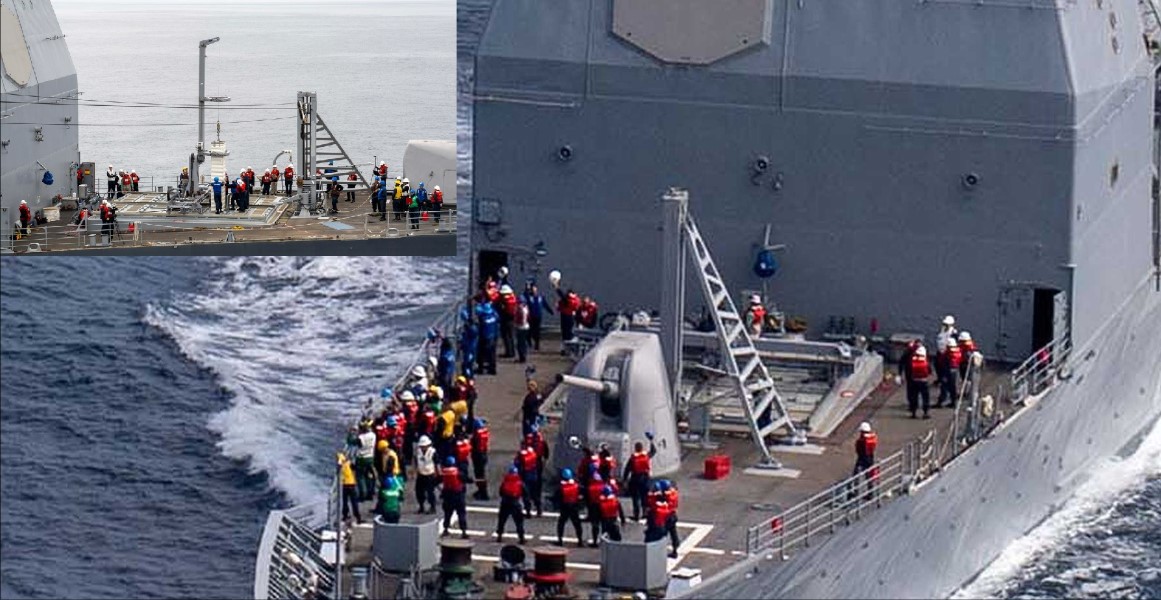
 www.thedefensenews.com
U.S. Navy Successfully Tests At-Sea Missile Reloading System in Major Naval Exercise
U.S. Navy has tested a new system for reloading missiles at sea—a move aimed at keeping warships armed and ready without needing to return to port. This t
www.thedefensenews.com