Is there any advantage for the RAN to disperse the basing of their larger vessels to other deep water harbours away from East Base West e.g. Port Kembla ,H.M.A.S Port Coonawarra Darwin which is the closest deepwater port to Asia. It seems that the East Base is based on a heritage factor from the time of ships of sail any thought?
To what end?
Dispersal for dispersals sake is pointless, so what is the problem you are trying to solve?
If it's defence, historically speaking, concentration is better. Our major fleet units are very valuable (as has always been the case), and killing in port is easier than at sea. But killing with what? Stirling and FBE are out of range of the vast majority of heavy threat's, they have easily surveilled surface approaches and being in two locations mean that cUAS is easier. The latter is particularly important, at the moment the cUAS bill is for two ports, every dispersal increases that cost by another port. Note that the UK, US, USSR, Italy, France and Japan (all with significant naval power at some point in the 20/21st centuries) all concentrated their fleet in a small number of ports - even when the threat was signficant (looks at Scarpa Flow)
If it's time to action, there are two issues. First is that ships often use the time between Sitrling/FBE and their AO to drill - unlike Army or Air Force they don't keep all their skills up to speed when in harbour. So there is some force prep time that you lose. Secondly is the threat mentioned above. Thirdly, where is the area of action? If it's the MEAO (like the majority of deployments in the 21st century have been), you don't gain anything. If it's the Pacific or Coral Sea, likewise. If it's equal or north of Mindanao, then the 5 days saved don't really matter (I'm sure that the sailors will disagree with me...).
Of course, that's only focused on the fighting bit. The actual reason for ports - the maintenance, life support, navy base 'stuff'. The Captain Cook Graving Dock is literally worth more to the fleet than if you filled it entirely with gold (although then we could afford SSNs.....). It's literally irreplicable. But the big cranes, the heavy repair parts storage, the fuel lines, the whole bit. Duplicating that becomes crazy expensive.
One issue that I seem to recall cropping up repeatedly are retention issues caused by personnel getting posted to bases in areas with less opportunities available for partners/families, and/or the facilities being a very long way away from family. It has been my understanding that the desire to establish a RAN sub facility somewhere on the East Coast is related to issues the RAN had with attracting and retaining submariners with all RAN sub ops being homeported at FBW.
This is absolutely true. Dispersal will suit some of the sailors/officers, but most of them won't appreciate it. Having a major east and west coast base, with a minor NE and N base, suits recruiting and retention significantly.
Strange that affects the RAN but not the rest of ADF…
/sarcasm off.
It obviously does, RAN just seems exempt from the push to house all ADF units in the North.
As stupid as the push north has been retrospectively (and I look back on my northern postings with significant fondness) from a retention point of view, there is one significant difference between Navy and the other two. With the exception of a handful of units, the majority of Army and RAAF personnel will spend most of their time at home during a posting. Yes, in the 2000s/10s there were deployments to the ME, but that was all three services. For the average Army unit, there will be a couple of FTX working up to a Div Warfighter or Talisman Sabre. 6 - 8 weeks field plus another 4 - 6 away getting there and back. a RAN unit could be spending 3 - 4 months deployed in the region 2 - 3 times in a year. Critically, while the Army/RAAF units are most likely to exercise in Australia (yes, Red Flag. Yes, Balikatan, Yes, PNG - I said likely), the Navy will often have unreliable comms. It's harder to get a sailor home. All this means that the average sailor's family need more stability and a persistence in support networks, because it's harder to support their family when they are in the fleet.
Anecdotally, it also appears that there is a difference between the services during standdown. Based on numerous years experience in the NT across all three Services, the PB crews deal with their off-time very differently to the others. My peers and I think it has something to do with the permanence of the networks - that while Air Force and Army can build the community ties, the PB crews struggle, because they are away so often for such time. More than once, the topic has come up in the Joint environment this discrepancy has come up - and that dates back to early 2010s.
Another way to look at it can facilities be in place for ships to replenish elsewhere during hostilities that cuts back on travel time for ships that may have expended their munitions and need to quickly replenish , it might be ships returning to a known predictable port are at risk e.g. mines submarines. The R.A.A.F has quite a number of airfields that provide in a way a similar backup easing dispersal
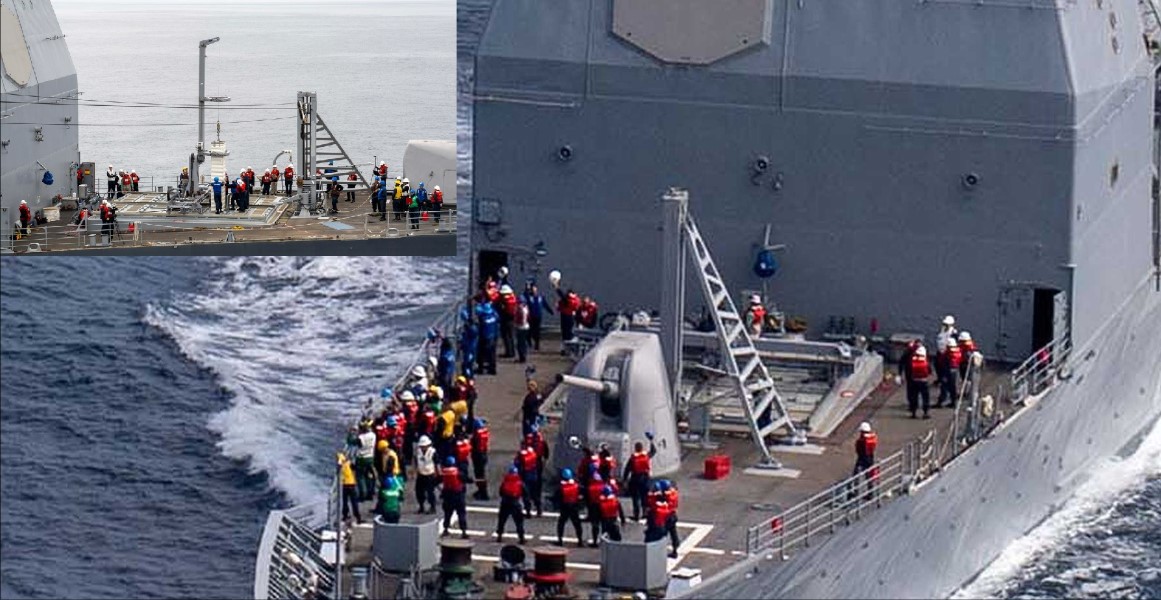
We have that. There are a number of ports identified with appropriate EO licenses ready to go, wharves to take cranes and the like. We have been rehearsing for years now -
here is HMCS Ville de Québec being done in Darwin and
HMCS Vancouver being done in Broome. Yes, reload of VLS at sea is an issue, but between JLC and the RAN we've had the capability to do forward rearming and reloading for a while now. It's been done for RN, RCN, USN and RAN ships across 20mm, 30mm, 5" and a variety of VLS.
And ships can refuel and restock at sea. I am in the team thinking that an expanded oiler fleet is advantageous.
Surely not?! The experts told me I could replace 8 Anzacs with 4 Hunters and 11 Mogami's, increase their AO and time at sea - but wouldn't need another AOR! SammyC, what are you thinking!?
I'm just glad our current AORs are super reliable
(and yes, watching a senior Admiral bite his tounge as I said the above to him was simultaneously entertaining and disappointing. Not that he disagreed, but that even with 41% of the IIP neither he nor my senior person could get anyone to back more AORs.....)

www.thedefensenews.com