Facing an environment of emerging fiscal constraints, the Army is using its Network Integration Evaluation efforts, part of the Agile Acquisition Process, to force a shift from Research, Developmental, Technical and Engineering efforts to the procurement of mature network capability that will be fielded starting in 2013.
This effort has resulted in significant cost savings from the restructure of Army programs and the consolidation of test practices.
The year-old Network Integration Evaluation, known as NIE, effort has driven decisions to send certain systems to the field, revamp others to better meet Soldier needs and terminate several programs that lacked merit, leading to significant cost savings and avoidance. Consolidating the evaluations with the 2nd Brigade, 1st Armored Division at White Sands Missile Range, N.M. and laboratory assessments at Aberdeen Proving Ground, Md., has also saved more than $7.9 million to date in test costs versus testing networked systems individually.
Much of the cost savings and avoidance stems from program adjustments made after NIE results prompted the Army to re-assess planned purchases or revise requirements. Examples include the cancellation of the Early Infantry Brigade Combat Team effort (including the Network Integration Kit) and the Mounted Soldier System program, and the restructure of the Nett Warrior and Joint Tactical Radio System, or JTRS, Ground Mobile Radio efforts.
Other savings result from risk reduction efforts, including robust laboratory and integration assessments prior to formal operational tests and the alignment of major network programs of record into an integrated “capability set.”
Synchronized fielding of capability sets every two years will allow the Army to buy the right amount and type of gear for the brigades that need it first, then incrementally modernize it — instead of spending resources on technology that may be out of date by the time it is needed.
“In the Nett Warrior situation, the formal requirement didn’t match up with what users were saying they needed to get the job done,” said Col. John Morrison, director of the Army G-3/5/7 LandWarNet-Battle Command Directorate. “The NIE gave us the opportunity to get the technology right, and to save significant time and money in the process.”
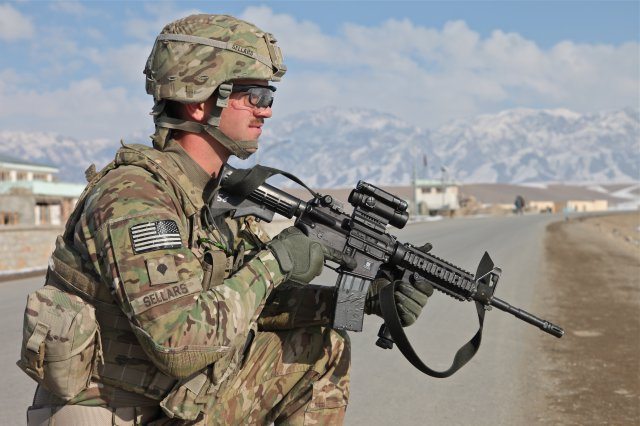
Nett Warrior is a Soldier-worn mission command system that 2/1 AD Soldiers deemed valuable but too bulky during the first NIE event in June 2011. Army leadership quickly restructured the Nett Warrior program to take advantage of the latest commercial technology, and a slimmed-down version of Nett Warrior received positive reviews at NIE 12.1 in November. These changes yielded more than $800 million in cost avoidance and resulted in a more usable end product for the dismounted Soldier, to be delivered to more units on a faster timeline.
Another major programmatic change related to the NIE is the termination of the Joint Tactical JTRS Ground Mobile Radio, or GMR. Soldiers at NIE 11.2 desired the GMR’s communications potential but criticized its size, power consumption and startup time.
When a decrease in the planned purchase quantity of GMR radios triggered a rise in unit cost and a subsequent Nunn McCurdy Breach, the Department of Defense decided not to re-certify the program, thus clearing a path for the Army to pursue lower cost, mature alternatives within the available radio market.
The Army is now using the Agile Process to procure a GMR replacement, known as the Mid-Tier Networking Vehicular Radio, or MNVR. This Non-Developmental Item, known as NDI, effort aims to procure available radios that transmit information using high bandwidth, non-proprietary waveforms such as Wideband Networking Waveform, or WNW, and Soldier Radio Waveform, or SRW, to move voice, video, data and images across the force in real time. The Army will leverage NIE 13.1 in the fall to test potential MNVR solutions and determine which will be fielded for Capability Set 14.
“We know the waveforms, not the hardware, are the key to this capability,” said Col. Dan Hughes, director of the Army’s System of Systems Integration Directorate. “We can now go back out to industry to get those waveforms on hardware that is cheaper and can be delivered to the Soldier faster. This is what this adaptive process is all about, making sure we provide the Soldier the most technically advanced, easily usable and cost-effective capability quickly.”
The Army will now use Capability Set Management, an adaptive and agile process, to sync network development and fielding with the Program Objective Memorandum cycle, thereby ensuring that the right amount of funding is in place at the right time for all components of the Capability Set. By fully aligning fiscal resources, development and fielding, the Army ultimately will field a greater depth of capability to more formations than was possible before.
Capability set fielding will be accomplished through the Agile Process, the Army’s new quick-reaction acquisition methodology to address defined capability gaps and insert new technologies into the overall network at a lower cost. Industry participation in the NIE and Agile Process is growing steadily, a key factor as the Army shifts from developing its own network technology to leveraging industry innovation.
More than 40 industry technologies will be included as part of NIE 12.2 in April-June.
“Starting next year we will field the network as an integrated capability, and it makes sense to evaluate it that way,” Morrison said. “The operational and financial benefits of the NIE will continue to build as we make this new model our established way of doing business.”
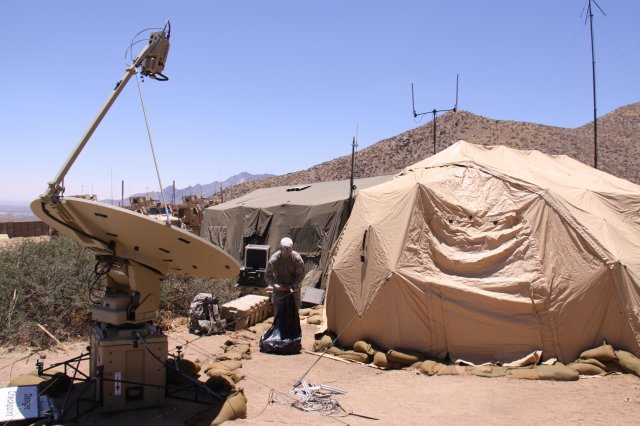
The NIE events themselves are also evolving. NIE 12.2 will operate in a classified environment with secure data connections and will connect evaluation units to a higher-division headquarters, being represented by the 101st Airborne Division operating out of Fort Campbell, Ky. 2/1 AD operations at White Sands will require the brigade, battalion and company command posts to “jump” or move in uncooperative and unpredictable environments, and quickly establish network connectivity.
A battalion-sized opposition force will be employed in dynamic scenarios with hybrid threats, including conventional forces, insurgents and members of the local population.
“From a test perspective, the NIEs are a very effective way to simultaneously measure individual system performance and validate the integrated network architecture in a robust operational environment,” said Maj. Gen. Genaro Dellarocco, commanding general of the Army Test and Evaluation Command. “While there are certainly challenges in evaluating so many systems at once, we believe there is little downside to quickly putting promising capabilities in Soldiers’ hands. We are confident in our test methods and that these synergies will save the Army significant dollars over time.”
Launched in June 2011, the NIEs are semi-annual evaluations designed to quickly integrate and mature the Army’s tactical communications network — the service’s top modernization priority. The events assess new network capabilities from government and industry with an operational brigade combat team to determine whether they perform as needed, conform to the network architecture and are interoperable with existing systems.
If a certain system is deemed in need of further development, for example, it can participate in a subsequent NIE before a final procurement or fielding decision is made.
“We intend to buy commercial technologies that represent the best capability at the best cost to the taxpayer,” Hughes said. “We’re going to compete to bring the prices down to a point where capabilities are commodities that fill our needs. The Agile Process will ultimately streamline acquisition so it is more incremental and more affordable.”