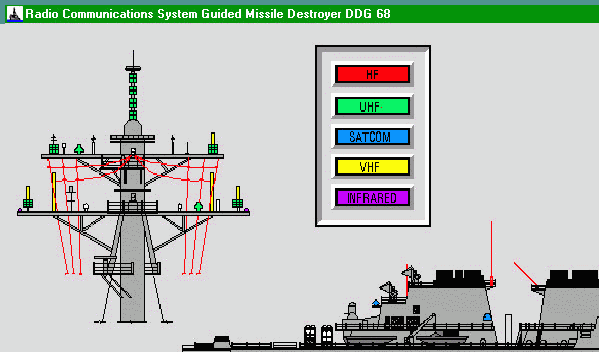
There are a number of issues to consider in the electromacnetic design of ships. The design process should encompass the entire ship project evolution and focus on the optimisation of both electromagnetic compatibility (EMC) and the radar cross-section (RCS) aspects.

The problem of matching the requirements of modern naval units with the growing number of electronic systems, together with survivability requirements, imposes the need for significant improvements in the approach to the electromagnetic (EM) design of new ship platforms. Significant EM design (see Figure 1) is a relatively recent discipline, which has evolved as a consequence of the improvements in the hardware tools available to support complex analyses required by the EM designer moving from the experimental approach through to the extended and systematic use of prediction tools. Stringent design requirements and changes to procurement strategies introduced the need to anticipate significant risks at the earliest stage of a project, and to design effective solutions for reducing and controlling their impact as changes get introduced through the ship design cycle.
Cooperation
It is evident that the solution to these problems must be pursued in a concurrent way, through cooperation between naval architects, mission planners and the EM design team. This kind of cooperation must start from the outset of the ship design process, when the preliminary design is carried out and where the major architecture, weapon and sensor choices are often made. During this initial stage, the timely contributions from the different engineering disciplines are more demanding but provide greatest benefits to the ship project. To be effective, these interactions must continue throughout the project development and up to delivery.
It is well known how the definition of structural details as well as construction tolerances can influence the ship radar signature and, to a lesser extent, the EMC effectiveness. For such design considerations, a primary consideration is given today to the extensive use of numerical simulation, which can provide the easiest, and sometimes only, means for supporting the design of complex ship systems. To be effective, a prediction system should combine all of the features required for the use of the computational electromagnetic solvers and the specific features for concurrent design into an integrated framework to provide a unified environment for the electromagnetic design. In this framework, the ship CAD drawings and related combat system information are shared by the different EM analysis areas (EMC, signature), and are fully open to import from or export to other ship project areas as required.
Experience shows that very often, naval architects, ship design specialists, RCS and EMC engineers act independently and, in many cases, lose the ability to optimise the ship’s configuration through balanced judgement and compromise. To achieve the best solution, the following should be provided to the naval engineer:
Control of the configuration of the ‘ship system’. The framework must be capable of providing project management services to organise all of the EM analyses during the ship project evolution. The framework must also supply configuration control aids on the ship architectural (shapes, materials) and electromagnetic (fields, signatures) database, in order to keep track and have a synthetic vision of the electromagnetic performance of each project version.
Open and integrated modelling environment. The geometric and electromagnetic characterisation of the ship model should be performed in a unified CAD environment, closely interfaced to the CAD drawings that may be defined and manipulated using the different 3D modelling tools used by naval architects.
Advanced electromagnetic codes. The system must have the complex set of state-of-the-art techniques needed for the electromagnetic computations (radiated/scattered fields) embedded into it. The system must also provide advanced simulations of all the aspects related to ship electromagnetic design, exploiting the capabilities of modern hardware resources to reduce computation time. _ There are a number of issues to consider in the electromagnetic design of ships.The design process should encompass the entire ship project evolution and focus on the optimisation of both electromagnetic compatibility (EMC) and the radar cross-section (RCS) aspects.
AUTHOR BIOGRAPHY
Dr Stefano Chiti,
Manager
http://www.armedforces-int.com/article.asp?pubID=15&catID=285&artID=488
The problem of matching the requirements of modern naval units with the growing number of electronic systems, together with survivability requirements, imposes the need for significant improvements in the approach to the electromagnetic (EM) design of new ship platforms. Significant EM design (see Figure 1) is a relatively recent discipline, which has evolved as a consequence of the improvements in the hardware tools available to support complex analyses required by the EM designer moving from the experimental approach through to the extended and systematic use of prediction tools. Stringent design requirements and changes to procurement strategies introduced the need to anticipate significant risks at the earliest stage of a project, and to design effective solutions for reducing and controlling their impact as changes get introduced through the ship design cycle.
Cooperation
It is evident that the solution to these problems must be pursued in a concurrent way, through cooperation between naval architects, mission planners and the EM design team. This kind of cooperation must start from the outset of the ship design process, when the preliminary design is carried out and where the major architecture, weapon and sensor choices are often made. During this initial stage, the timely contributions from the different engineering disciplines are more demanding but provide greatest benefits to the ship project. To be effective, these interactions must continue throughout the project development and up to delivery.
It is well known how the definition of structural details as well as construction tolerances can influence the ship radar signature and, to a lesser extent, the EMC effectiveness. For such design considerations, a primary consideration is given today to the extensive use of numerical simulation, which can provide the easiest, and sometimes only, means for supporting the design of complex ship systems. To be effective, a prediction system should combine all of the features required for the use of the computational electromagnetic solvers and the specific features for concurrent design into an integrated framework to provide a unified environment for the electromagnetic design. In this framework, the ship CAD drawings and related combat system information are shared by the different EM analysis areas (EMC, signature), and are fully open to import from or export to other ship project areas as required.
Experience shows that very often, naval architects, ship design specialists, RCS and EMC engineers act independently and, in many cases, lose the ability to optimise the ship’s configuration through balanced judgement and compromise. To achieve the best solution, the following should be provided to the naval engineer:
Control of the configuration of the ‘ship system’. The framework must be capable of providing project management services to organise all of the EM analyses during the ship project evolution. The framework must also supply configuration control aids on the ship architectural (shapes, materials) and electromagnetic (fields, signatures) database, in order to keep track and have a synthetic vision of the electromagnetic performance of each project version.
Open and integrated modelling environment. The geometric and electromagnetic characterisation of the ship model should be performed in a unified CAD environment, closely interfaced to the CAD drawings that may be defined and manipulated using the different 3D modelling tools used by naval architects.
Advanced electromagnetic codes. The system must have the complex set of state-of-the-art techniques needed for the electromagnetic computations (radiated/scattered fields) embedded into it. The system must also provide advanced simulations of all the aspects related to ship electromagnetic design, exploiting the capabilities of modern hardware resources to reduce computation time. _ There are a number of issues to consider in the electromagnetic design of ships.The design process should encompass the entire ship project evolution and focus on the optimisation of both electromagnetic compatibility (EMC) and the radar cross-section (RCS) aspects.
AUTHOR BIOGRAPHY
Dr Stefano Chiti,
Manager
http://www.armedforces-int.com/article.asp?pubID=15&catID=285&artID=488